
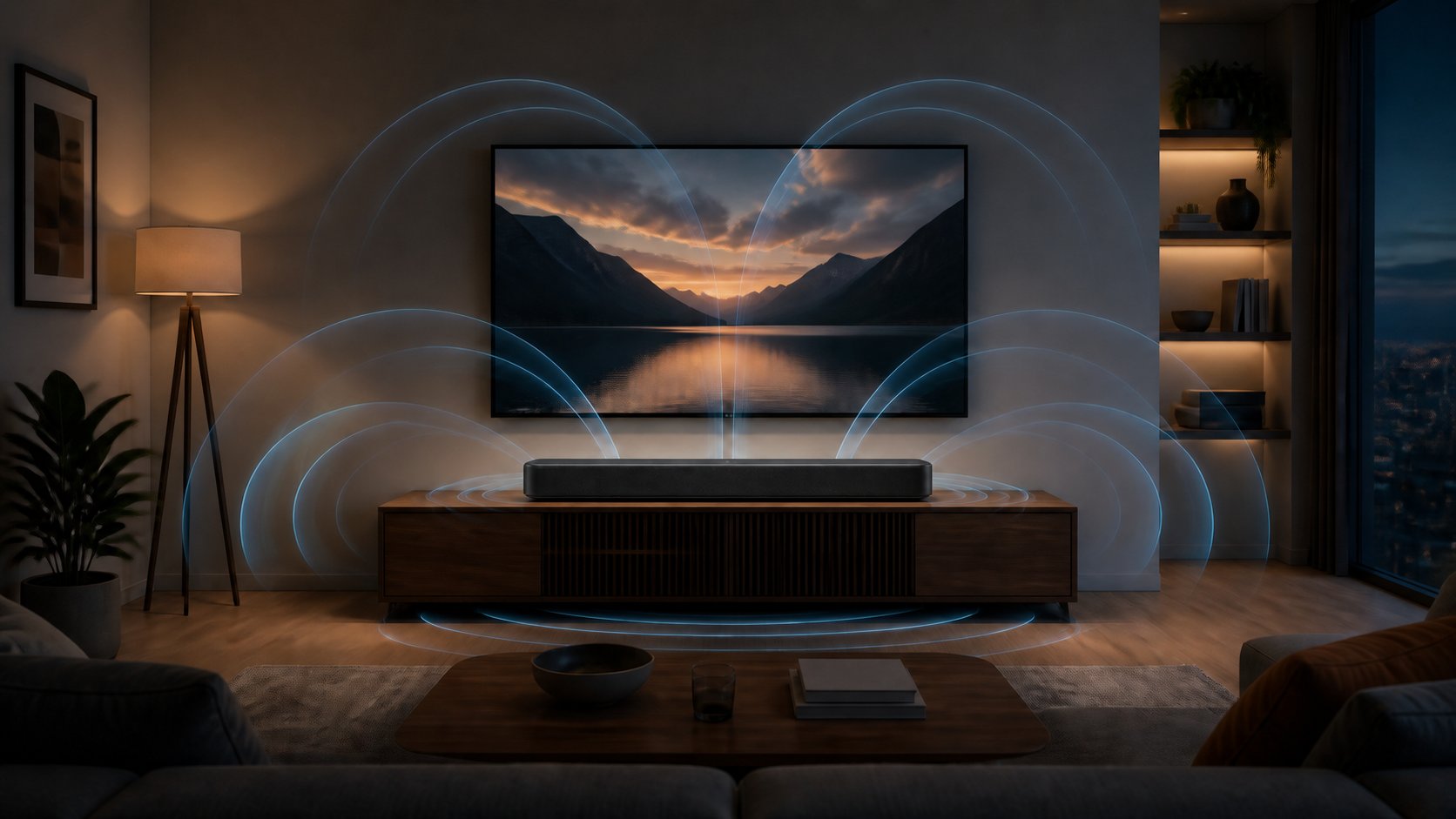
A Samsung HW-QS90H review has to separate two ideas that “all-in-one” advertising tends to merge. The 2026 QS90H genuinely puts the soundbar, bass drivers, and 7.1.2-channel speaker array into one enclosure. It does not place physical speakers behind your seat or a dedicated subwoofer on the floor.
That distinction defines the purchase. The QS90H is compelling when removing extra boxes and power cables matters more than maximizing physical surround separation and low-frequency scale. Its $999.99 US price is harder to justify if your room can accommodate a complete subwoofer-and-rear-speaker system or if you only need clearer television dialogue.
Gearxis has not listened to or measured the QS90H. This is an evidence-based purchase assessment using current Samsung specifications, Samsung’s April 2026 product announcement, and official competitor information checked August 7, 2026. Statements about room-filling sound, bass control, and AI processing remain manufacturer claims rather than Gearxis test results.
Quick Verdict
Buy the QS90H if you want a premium Dolby Atmos and DTS:X soundbar without finding space or power for a separate subwoofer and rear speakers. It is especially coherent with a compatible Samsung TV, where Q-Symphony and Samsung’s broader audio controls add value beyond the bar itself.
Skip it if true rear-speaker placement, a dedicated subwoofer, or 4K/120Hz passthrough through the soundbar is essential. It is also unnecessary for someone who wants only a modest dialogue and volume upgrade from television speakers.
What “All-in-One” Actually Includes
Samsung specifies a 7.1.2-channel arrangement with 13 internal speakers. The enclosure contains front-, side-, wide-, and up-firing drivers plus four built-in woofers. No wireless subwoofer or rear speakers are included.
That hardware is intended to reflect sound from the room and create width and height from the front wall. Samsung supports Dolby Atmos, DTS:X, and Eclipsa Audio, but a channel label does not guarantee the same spatial result in every room. Ceiling height, wall distance, seating position, furnishings, and source content all affect reflected and processed sound.
The single enclosure removes two common setup burdens. There is no subwoofer footprint near the television and no rear-speaker power arrangement behind the seating area. Renters, apartment residents, and rooms with open walkways may value that simplicity more than an enthusiast who already has wiring and speaker locations planned.
Measure the Console Before Judging the Simplicity
The QS90H is still a substantial object. Samsung lists dimensions of 1245 x 68.8 x 125 mm and a weight of 6.7 kg. Converted, that is approximately 49.0 inches wide, 2.7 inches tall, 4.9 inches deep, and 14.8 pounds.
The absence of a subwoofer does not help if the bar overhangs a narrow media console or blocks the lower edge of the television. Measure usable width and depth, then check the television stand position and infrared receiver. Leave room for the HDMI and power connections rather than treating the published depth as the complete installation requirement.
Samsung includes a wall-mount bracket. Its Convertible Fit system uses a gyro sensor to detect whether the soundbar is mounted vertically against the wall or resting flat on furniture, then changes speaker roles for the intended 7.1.2-channel arrangement. That is more useful than a cosmetic rotation because up-firing behavior depends on orientation.
Connectivity Is Broad, but Gaming Passthrough Has a Limit
The QS90H includes one HDMI input, one HDMI output with eARC, and an optical input. Wireless options include Wi-Fi and Bluetooth 5.3, while listed streaming support includes AirPlay, Chromecast, Spotify Connect, Tidal Connect, and Roon. Samsung does not list USB music playback.
The HDMI input passes 4K video at 60Hz with HDR10+. That is sufficient for films, television, and 60Hz game output, but it is not the correct signal path for a console or PC targeting 4K at 120Hz. In that setup, connect the gaming device directly to a compatible television and return audio to the QS90H through HDMI eARC. This preserves the television’s supported video path but requires enough suitable TV inputs.
Buyers with an older ARC-only television should also verify audio-format behavior. HDMI eARC is the cleanest route for the high-bandwidth formats listed by Samsung; actual output depends on the television, source device, application, and content.
Samsung TV Owners Receive the Strongest Ecosystem Case
Q-Symphony allows compatible Samsung televisions and audio products to play together instead of muting the TV speakers when the soundbar takes over. Samsung says compatibility begins with selected 2022-or-later TVs, with the exact number and type of supported audio devices depending on model year.
Other manufacturer-described processing includes SpaceFit Sound Pro for room calibration, Adaptive Sound for content-aware adjustment, AI Dynamic Bass Control, Sound Elevation, Active Voice Amplifier Pro, and Auto Volume. These features strengthen the Samsung-TV case, but they should not be read as independent proof of better sound. Their value depends on compatibility and whether you prefer automated processing over manual settings.
The QS90H also supports optional expansion. Samsung lists compatibility with its SWA-9500S rear speaker kit, while its 2026 ecosystem can incorporate selected Music Studio speakers through compatible Samsung TV and Q-Symphony configurations. Buying additional speakers changes the original one-box value proposition, so compare the resulting system price before expanding.
QS90H, Sonos Arc Ultra, or Samsung Q990H?
The Sonos Arc Ultra is the closest single-bar alternative. Sonos listed it at $1,099 during this check, $99.01 more than the QS90H’s official US price. Arc Ultra offers Dolby Atmos, Trueplay room tuning, Wi-Fi, Bluetooth, AirPlay 2, HDMI eARC, and a modular path to Sonos Sub and Era rear speakers.
Choose QS90H for the lower official price, dedicated HDMI input, DTS:X support, Convertible Fit, and integration with a compatible Samsung TV. Choose Arc Ultra when Sonos multi-room audio, Sonos Ace integration, or an existing Sonos household matters more. Do not choose between them by their advertised channel numbers alone; both use proprietary processing and driver layouts that Gearxis has not measured against each other.
Samsung’s HW-Q990H answers a different question. Samsung lists it at $1,999.99 as an 11.1.4-channel package with a separate subwoofer and rear speakers. The official price gap from QS90H is exactly $1,000.
That extra $1,000 pays for a physically distributed system rather than merely a higher model number. Choose Q990H when your room can place and power the extra components and physical surround coverage is the goal. Choose QS90H when removing those components is the goal.
The Gearxis Three-Part Fit Test
- Room test: Can you place a subwoofer and rear speakers without obstructing walkways, upsetting neighbors, or running awkward power cables? If no, QS90H’s architecture solves a real problem.
- Signal test: Must a game console pass through the soundbar at 4K/120Hz? If yes, use a compatible TV’s inputs and eARC or choose different hardware.
- Expectation test: Do you want a spacious front-wall presentation or effects physically originating behind the seating position? The second expectation calls for rear speakers, whether purchased now or later.
Pass the room test in favor of one enclosure, accept the signal routing, and set realistic spatial expectations, and the QS90H is a focused premium option. Fail any of those checks and its clean design may be solving the wrong problem.
The Samsung HW-QS90H fulfills the structural part of the all-in-one promise: 13 speakers, four built-in woofers, immersive-format support, and room-aware features live in one bar. Whether it fulfills the sonic promise cannot be established from specifications alone. Its strongest recommendation is therefore specific: buy it to remove components without dropping to an entry-level soundbar, not as a guaranteed replacement for physical rear speakers and a dedicated subwoofer.