
This Anker Laptop Power Bank review examines a specific travel problem: keeping a USB-C laptop and smaller devices running without packing a separate cable for every connection. The 25K, 165W model’s 90Wh battery, two built-in USB-C cables, and four-device support make it far more capable than a pocket-size phone charger. They also make it a 21-ounce object that needs to earn its place in your bag. For broader category context, see Gearxis’s 2026 power-bank buying guide.
Anker Laptop Power Bank Review in Brief
The Anker Laptop Power Bank is a strong fit for a traveler or mobile worker who regularly carries a USB-C laptop plus a phone, tablet, camera, or handheld console. Its central advantage is not simply the 165W number. It is the combination of meaningful capacity, up to 100W from any one USB-C connection, and two cables that cannot be forgotten at home.
The trade-off is equally clear. At 595g, this is not a power bank to carry “just in case” when a small phone top-up would be enough. It also does not send 165W through one cable: a single laptop receives up to 100W, while the larger figure describes shared output. Buy it to replace a small collection of charging gear, not because the headline wattage sounds fast.
What This Review Can—and Cannot—Establish
Gearxis has not performed hands-on charging, thermal, durability, or efficiency tests on this unit. This review is based on Anker’s official specifications and power-distribution guidance, current FAA battery rules, and a comparison with the closest retractable-cable alternative. Manufacturer timing and output estimates are identified as claims rather than Gearxis measurements.
The exact model covered is A1695. Anker lists a 25,000mAh capacity at 3.6V, equivalent to 90Wh, along with a 595g weight and dimensions of approximately 6.18 by 2.13 by 1.93 inches.
| Decision fact | What it means |
|---|---|
| 90Wh rated energy | Below the FAA’s general 100Wh threshold, subject to carry-on and airline rules |
| 100W maximum from one USB-C connection | Suitable for many USB-C laptops, but not a 165W single-device supply |
| 165W maximum shared output | Most useful when charging two USB-C devices together |
| Two built-in USB-C cables | Less cable clutter and one fewer item to forget |
| 595g / 21.0 oz | A meaningful addition to a commuter or carry-on bag |
The Cables Are the Main Reason to Choose It
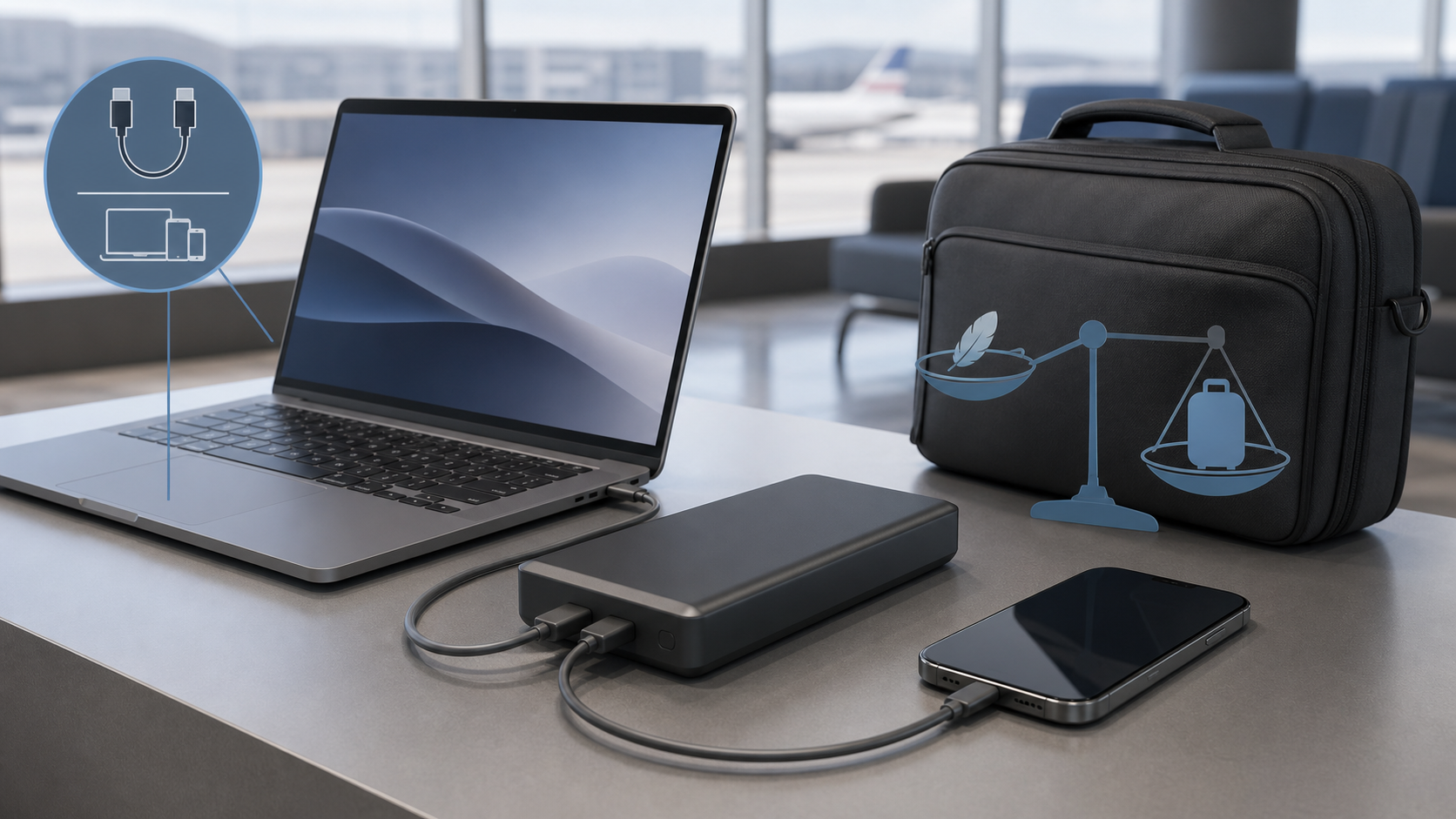
Many high-output power banks can charge a laptop. This Anker model’s more distinctive advantage is that two of its three USB-C connections are already attached. One is a 27.6-inch retractable cable; the other is an 11.8-inch fixed cable that also forms a short carrying loop. A separate USB-C port and USB-A port complete the four-device layout. The cable dimensions come from Anker’s support guide.
That arrangement changes the buying decision. If the bank replaces both a smaller battery and two loose cables, its weight becomes easier to defend. If you already keep a carefully organized cable pouch, the integrated design offers less benefit and introduces two permanently attached parts that cannot simply be swapped like an ordinary cable. Anker provides instructions for extending and retracting the cable, but Gearxis has not tested long-term cable wear.
What 165W Actually Means
The name can create the wrong expectation. According to Anker’s output guidance, each USB-C connection can provide up to 100W when used alone. Two USB-C connections can share up to 165W. A USB-C and USB-A pairing is listed at up to 133W, while three- and four-device use drops the combined maximum to 130W.
In practical terms, this is better understood as a 100W laptop power bank with extra output headroom for a second device. It can give a compatible laptop the bank’s highest single-port rate while allocating remaining power to a phone or tablet. It cannot provide 165W to one gaming laptop or workstation through one USB-C cable. Your device, charging protocol, battery level, cable path, and port combination still determine the actual rate.
Anker also notes that the highest distribution figures require sufficient remaining charge and may reduce at lower battery levels. That limitation matters more than the box number for anyone expecting sustained multi-device output near the end of a trip.
Capacity Versus Carry Weight
The official 90Wh rating allows a useful, transparent calculation: 90Wh divided by roughly 1.31 pounds equals about 68.7Wh of nominal stored energy per pound. This is not a measurement of usable output; conversion losses mean a connected device receives less energy than the cells nominally store. It is simply a way to make the capacity-and-weight trade-off visible.
The result points to the right use case. A 21-ounce bank makes sense when a laptop top-up can save a work session, when several devices need power between outlets, or when two built-in cables replace other items in the bag. It is excessive for a short commute with only a phone and earbuds. A lighter battery that you consistently carry is more useful than a larger one left at home.
Recharging and the Display
Anker says the bank can recharge at up to 100W through any USB-C connection and estimates a full recharge in about two hours with a 100W-or-higher charger at 77°F. The company also says the 100W peak input is available only while the bank remains above 25% charge. Because Gearxis did not time this process, treat two hours as a controlled manufacturer estimate rather than a guaranteed result.
The built-in display reports remaining battery, input or output power, port activity, and estimated charging time. That information is more useful here than a simple four-dot indicator because it can reveal whether a laptop negotiated a high-power connection and how output changes when another device is added. It does not replace independent efficiency or temperature testing.
Travel Use Requires More Than a “Flight-Approved” Label
The 90Wh rating falls below the FAA’s general 100Wh ceiling for lithium-ion batteries on passenger aircraft. However, current FAA guidance says power banks must travel in carry-on baggage, be protected from damage and short circuits, and be removed if a carry-on bag is checked at the gate. Airlines may impose stricter rules, so verify the carrier’s policy before travel.
That makes the Anker suitable in capacity for many U.S. flights, but “flight-approved” should not be read as permission to pack or use it however you want. Rules can vary by airline and country, and damaged or recalled batteries should not travel.
The Closest Alternative
The UGREEN Nexode 20,000mAh 165W targets a similar buyer with 165W dual-device output and a built-in retractable USB-C cable. The choice is not about which 165W label is larger; they are the same.
Choose the Anker when the larger 25,000mAh nominal capacity and second built-in USB-C cable better support a laptop-centered travel kit. Consider the UGREEN when 20,000mAh is enough and one retractable cable covers your routine. Current prices change, so compare live prices only after deciding which capacity and cable layout you would actually carry.
Who Should Buy It—and Who Should Skip It
Buy the Anker Laptop Power Bank if you regularly work away from outlets, carry two or more USB-C devices, and value an all-in-one kit more than a lightweight bag. It is especially sensible when your laptop accepts 65W to 100W USB-C charging and a phone or tablet often needs power at the same time.
Skip it if your main device is a phone, if every ounce matters, or if your laptop needs more than 100W from a single connection to maintain demanding workloads. It is also a weaker fit if you prefer replaceable loose cables and do not want cable mechanisms built into the battery.
The product’s real value is therefore narrow but convincing: it reduces charging-kit friction for laptop travelers. For that user, the 21-ounce cost can be reasonable. For everyone else, the same weight is the clearest reason to buy less power bank.