
Quick Decision
Choose AirPods Pro 3 if your daily devices are an iPhone, Apple Watch, iPad, and Mac—and especially if Apple’s hearing-health features, workout heart-rate sensing, Find My integration, and automatic switching are useful to you.
Choose Galaxy Buds 4 Pro if you use a compatible Samsung Galaxy phone and want Samsung’s 24-bit/96kHz audio path, One UI controls, Galaxy AI access, Auracast, and a slightly longer manufacturer-rated total listening time with the charging case.
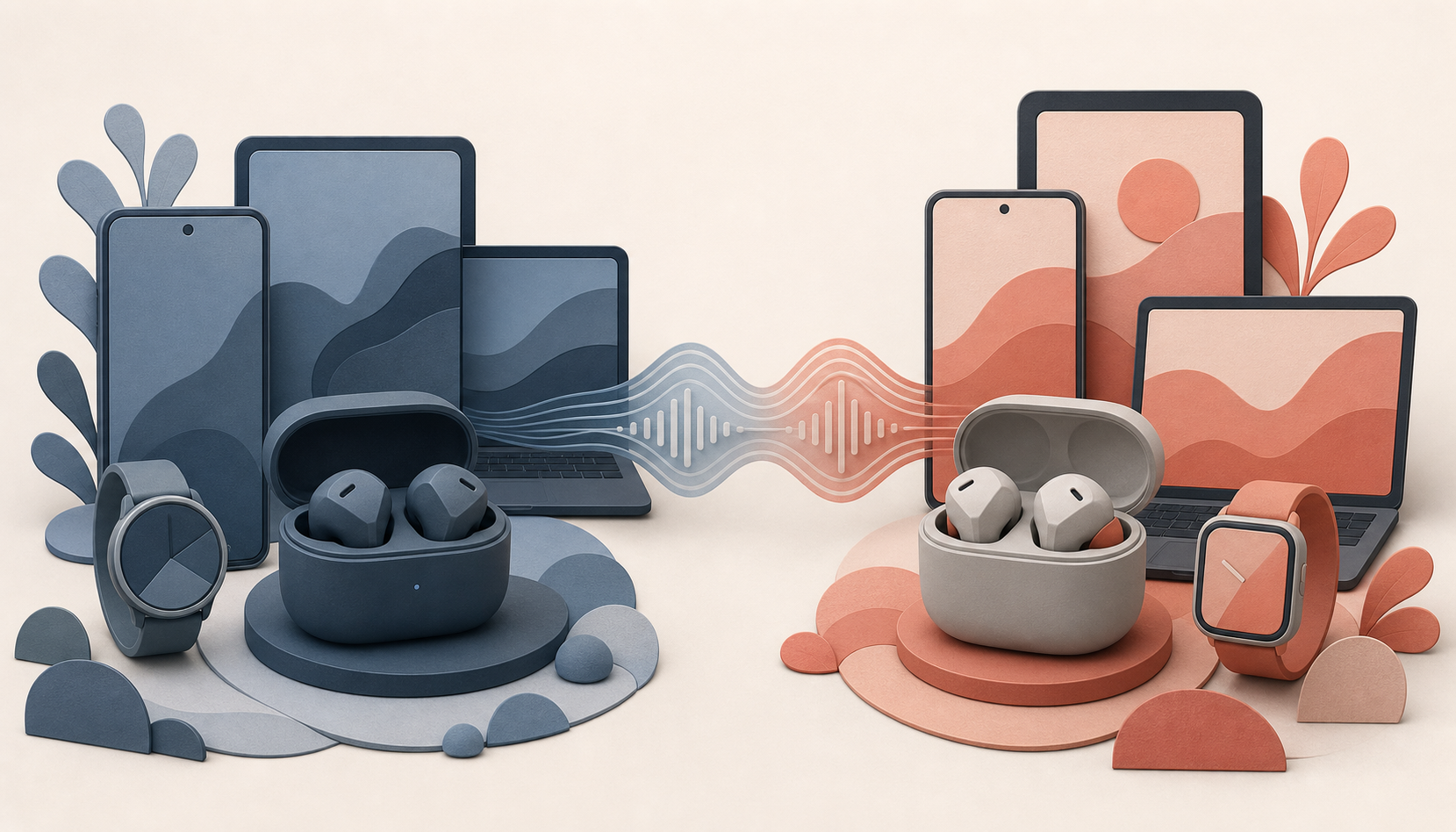
The important caveat is that neither product delivers its complete feature set on every Bluetooth device. AirPods work as Bluetooth headphones with non-Apple hardware, but Apple says functionality may be limited. Samsung likewise supports standard Bluetooth audio across operating systems, while advanced settings need Android and several headline features require a compatible Galaxy device. If you plan to cross ecosystems, compare the reduced feature set—not the advertisements built around each company’s own phone.
This comparison covers the AirPods Pro 3 introduced in September 2025 and the Galaxy Buds 4 Pro introduced in February 2026. It is based on current Apple and Samsung documentation, not Gearxis listening, fit, microphone, or noise-cancellation testing.
AirPods Pro 3 vs Galaxy Buds 4 Pro Specs
| Feature | AirPods Pro 3 | Galaxy Buds 4 Pro |
|---|---|---|
| Fit | Sealed in-ear, five silicone-tip sizes | Sealed canal fit, three silicone-tip sizes |
| Earbud weight | 5.55g each | 5.1g each with medium tip |
| ANC playback claim | Up to 8 hours per charge; 24 hours with case | Up to 6 hours per charge; 26 hours with case |
| Connectivity | Bluetooth 5.3 | Bluetooth 6.1; Auto Switch |
| Water and dust rating | IP57 earbuds and charging case | IP57 earbuds; case is not water resistant |
| Charging | USB-C, Qi, MagSafe, or Apple Watch charger; USB-C cable sold separately | USB-C or wireless charging; USB-C cable and power adapter not included |
| Platform advantage | Apple automatic switching, Find My, hearing features, heart-rate sensing | Galaxy high-resolution SSC path, One UI controls, Galaxy AI, Auracast |
| Cross-platform reality | Standard Bluetooth use; features may be limited outside Apple | Standard Bluetooth use; advanced settings need Android, some features need Galaxy |
Manufacturer battery tests use different devices, software, settings, and procedures, so the numbers are planning references rather than a controlled head-to-head result.
The Ecosystem Is the Product
AirPods Pro 3 can be associated with an Apple Account for automatic device switching and Find My. That matters when a normal day moves from an iPhone call to a Mac meeting and then to an iPad or Apple Vision Pro. Apple documents Apple TV switching separately rather than including it in the automatic-switching device list. The case includes a speaker for Find My, and it accepts MagSafe, Apple Watch, Qi, and USB-C charging methods.
Apple’s distinctive extras go beyond device switching. Its specification page lists Hearing Test, Hearing Aid, Hearing Protection, Live Translation, and heart-rate sensing during workouts. Each has device, software, region, age, or language requirements, so they should be treated as compatibility-dependent features—not universal medical or translation guarantees. Still, a qualified user who already relies on Apple’s Health and Fitness environment has a reason to choose AirPods that a generic audio comparison would miss.
Galaxy Buds 4 Pro makes the parallel argument for Samsung users. Samsung lists simple case-open pairing, controls in One UI, Auto Switch, 24-bit/96kHz playback through its proprietary SSC UHQ path on supported Galaxy devices, 360 Audio, and AI-agent access from compatible Galaxy phones. Its specification sheet also lists AAC, SBC, LC3, Auracast, and Samsung’s SSC codecs.
Samsung provides a more explicit path for other Android phones: the Galaxy Wearable app can handle settings such as noise control, Adaptive EQ, pinch control, and updates on compatible Android devices. But Galaxy-only limits still matter. Samsung says its AI features require a compatible Galaxy phone, and its highest-quality SSC playback depends on specified Galaxy hardware and software.
The practical rule is simple: iPhone owners should need a specific reason to leave AirPods, and Galaxy owners should need a specific reason to leave Galaxy Buds. Owners of other Android phones should examine Samsung’s compatibility chart feature by feature rather than assume that buying the Android-side product unlocks every Galaxy feature.
Fit and Controls: Specifications Cannot Pick Your Ears
Both products use sealed in-ear designs with silicone tips. AirPods Pro 3 includes five sizes from XXS through L; Galaxy Buds 4 Pro includes three sizes. More tip sizes give AirPods a broader adjustment range on paper, while Samsung’s buds are lighter by 0.45g each—about 8% less than the AirPods’ listed weight.
Neither number proves comfort. Ear-canal shape, pressure, seal, skin sensitivity, and movement matter more than a small weight difference. A poor seal can also change perceived bass and noise cancellation. Buy from a seller with a workable return policy, and do not keep either product merely because its ecosystem is convenient if the fit is unstable or painful.
AirPods Pro 3 uses press and swipe controls, while Galaxy Buds 4 Pro uses pinch and swipe controls. AirPods adds Siri interactions and a camera-remote action on supported Apple devices. Galaxy Buds 4 Pro adds configurable pinch behavior and, under Samsung’s more conservative current compatibility guidance, requires One UI 8.5 or later for head gestures that accept or decline calls. These are convenience differences; they do not establish a sound-quality winner.
Sound and Noise Cancellation: No Paper Winner
Apple lists a custom driver, Adaptive EQ, Adaptive Audio, Transparency mode, Conversation Awareness, Personalized Spatial Audio, and active noise cancellation. Samsung lists an 11mm woofer plus 5.5mm planar tweeter, dual amplifiers, Adaptive EQ, Adaptive ANC 2.0, Ambient Sound, voice and siren detection, and 360 Audio.
Those designs are too different to rank from specifications. Driver count does not establish tonal accuracy, and a manufacturer’s ANC generation name is not a shared measurement standard. Apple claims AirPods Pro 3 removes up to twice as much noise as AirPods Pro 2 under its tests; Samsung describes improved Adaptive ANC relative to its own line. Neither claim is a controlled AirPods-versus-Galaxy result.
If sound is your deciding factor, compare both with the same tracks, source device, volume, and a secure fit. Pay attention to vocal balance, bass level, treble fatigue, transparency naturalness, and the kinds of noise you actually encounter. This article does not claim that Gearxis performed that test.
Battery: Earbud Time or Total Time?
Apple rates AirPods Pro 3 for up to eight hours per charge with ANC and up to 24 hours total with the case. Samsung rates Galaxy Buds 4 Pro for up to six hours per charge with ANC and 26 hours total with the case.
That creates a useful split. Using the companies’ own maxima, AirPods offers two more hours in one uninterrupted ANC session, a 33% increase over Samsung’s six-hour figure. Galaxy offers two more total ANC hours after case recharging, about 8% more than Apple’s 24-hour total. The first difference matters more on a long flight or work block; the second matters more when you can return the buds to the case between sessions.
Do not treat those percentages as laboratory proof that one battery lasts longer in identical use. Apple and Samsung tested with different phone generations and conditions, and features such as spatial audio, high-resolution playback, calls, heart-rate sensing, and signal quality can change runtime.
Water Resistance and Charging Case Risk
Both sets of earbuds carry an IP57 dust- and water-resistance rating. The case is where the comparison separates: Apple lists IP57 for both AirPods Pro 3 and its charging case, while Samsung says the Galaxy Buds 4 Pro case is not water resistant.
IP57 is not permission to swim with either product. Samsung specifically limits its description to fresh-water immersion under controlled conditions and advises against beach or pool use. Water resistance can also decline after damage or wear. Apple’s rated case is the more reassuring specification for a wet gym bag or unexpected rain, but both products still deserve ordinary care.
Both cases can charge through USB-C or a wireless charger, and neither product includes a USB-C charging cable. Apple documents two additional options for AirPods: MagSafe and an Apple Watch charger. Check what you already own before adding accessories to the purchase cost.
Who Should Avoid Each One
Avoid AirPods Pro 3 if your main phone is Android and you expect every Apple-specific hearing, fitness, switching, Find My, and translation feature to work unchanged. They can play Bluetooth audio, but basic compatibility is not the same as the full Apple experience.
Avoid Galaxy Buds 4 Pro if your main phone is an iPhone and you expect the Galaxy Wearable settings path, SSC high-resolution audio, Galaxy AI controls, or One UI integration. Standard playback remains possible, but the reasons to pay for the Pro model shrink outside compatible Galaxy and Android devices.
Avoid both if sealed silicone tips cause discomfort, if you need platform-neutral multipoint behavior across unrelated work devices, or if repairable batteries are a priority. In those cases, a different earbud design—or conventional headphones—may be the better category.
A Five-Question Decision Rule
- Which phone do you use every day? Choose the matching ecosystem unless a later answer gives you a concrete reason not to.
- Do you need Apple’s hearing or workout features? Verify eligibility and device requirements, then favor AirPods if those features are genuinely useful.
- Do you use a recent Galaxy phone for SSC audio, One UI controls, or Galaxy AI? Favor Galaxy Buds if those functions are part of your actual routine.
- Will you listen longer than six hours without using the case? Apple’s higher single-charge ANC claim is more relevant than Samsung’s higher case total.
- Will the charging case face dust or water exposure? Apple’s IP57 case rating is a meaningful hardware distinction; Samsung applies IP57 only to the earbuds.
If the answers remain tied, fit should decide. An earbud that seals reliably and stays comfortable is more valuable than an ecosystem feature you rarely use.