
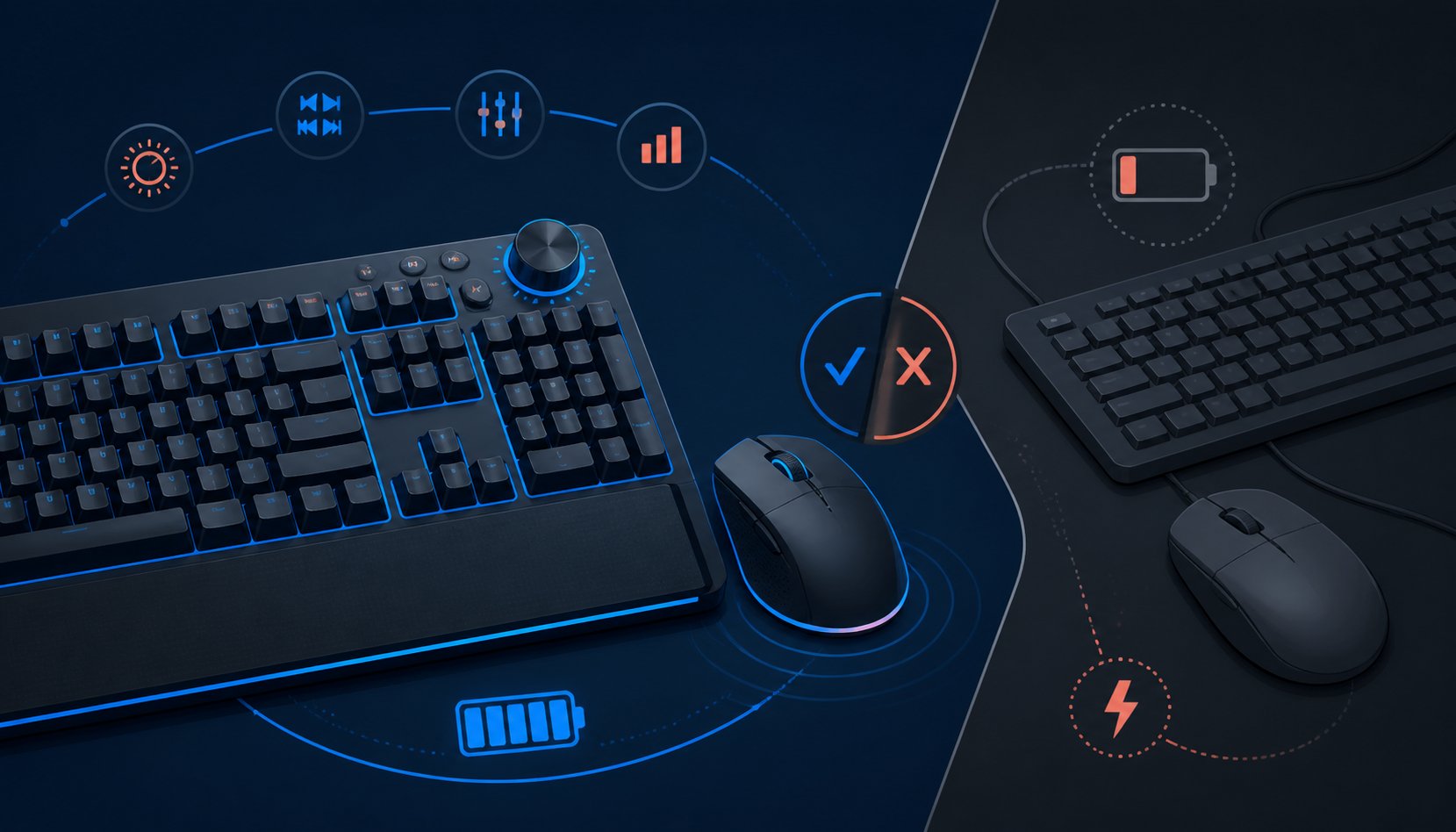
The Corsair SKIFF 100 and HARPOON v2 launch is built around two forms of convenience: a physical keyboard dial for frequent controls and a wireless mouse designed to spend less time charging. Those are useful improvements, but neither automatically makes this a necessary upgrade.
The SKIFF 100 and SKIFF 100 PLUS are full-size membrane keyboards rather than mechanical models. The HARPOON v2 WIRELESS is an ergonomic, right-handed mouse with three connection modes. Together, they make the strongest case for a first gaming setup or for replacing peripherals that already create recurring friction.
Gearxis has not handled, latency-tested, battery-tested, or durability-tested these products. This assessment uses Corsair’s August 2026 announcement as reproduced by APH Networks, plus current Best Buy listings. Battery life and other performance figures are manufacturer claims, not independent Gearxis measurements.
Quick Verdict
Consider the SKIFF 100 if you want a quiet full-size keyboard and frequently reach for media controls. Move to the SKIFF 100 PLUS only when six dedicated macro keys would become part of your normal workflow. The PLUS label is difficult to justify if those keys will remain unused.
The HARPOON v2 WIRELESS is more broadly appealing on paper. Corsair combines 2.4GHz wireless, Bluetooth, and wired USB-C operation with claimed wireless battery life of up to 140 hours. That flexibility can matter to someone who moves between a gaming PC and a work laptop.
Price changes the decision. On August 18, 2026, Best Buy listed both the SKIFF 100 PLUS at $69.99 and the HARPOON v2 WIRELESS at $69.99. Buying both would total $139.98 before tax. Prices and stock can change, so treat this as a dated comparison rather than a permanent MSRP.
Keep your current equipment if it already feels comfortable, holds a reliable connection, and does not interrupt you with awkward media shortcuts or frequent charging. Convenience features should solve a repeated problem, not manufacture a reason to replace working gear.
What Corsair Actually Announced
| Product | Main distinction | Best fit | Main caution |
|---|---|---|---|
| SKIFF 100 | Full-size membrane keyboard with rotary media dial | Quiet shared spaces and mixed work/play desks | No dedicated G-key column |
| SKIFF 100 PLUS | SKIFF 100 feature set plus six programmable G-keys | Repeated macros, hotkeys, or game commands | Extra keys matter only if you configure and use them |
| HARPOON v2 WIRELESS | Ergonomic tri-mode mouse with long claimed battery life | One mouse shared across wired and wireless devices | Shape, weight, and sensor feel require hands-on use |
Corsair says both keyboards include 10-zone RGB lighting, an IP53 rating, quiet membrane keys, a detachable soft-touch wrist rest, and adjustable tilt legs. Compatibility covers PC, Mac, Xbox, and PlayStation. Configuration uses the browser-based Corsair Web Hub. Best Buy’s current SKIFF 100 PLUS page independently lists its membrane construction, full-size wired format, media dial, six G-keys, IP53 protection, and Web Hub or iCUE configuration.
The HARPOON v2 WIRELESS uses Corsair’s claimed 26,000 DPI MARKSMAN sensor and has six programmable buttons. Best Buy’s product page also confirms its wired and wireless modes. These specifications describe capability; they do not prove comfort, tracking consistency, wireless latency, or longevity in an individual unit.
Is the SKIFF Control Dial Useful or Just Another Feature?
A dial is valuable when it replaces an action you perform repeatedly. Volume adjustment is the obvious case: rotating a control can be faster and easier to locate than using a function-key combination, especially during a call, game, or full-screen video. Corsair also describes mute, play, pause, and track navigation through the media controls.
That advantage is practical rather than transformative. It does not change the SKIFF’s membrane key mechanism, full-size footprint, or typing feel. Someone shopping specifically for mechanical switches, adjustable actuation, hot-swappable switches, or a compact layout should not let the dial redirect the purchase.
The distinction between the two keyboards is similarly simple. Buy the PLUS only if you can name several commands for its six G-keys before ordering. Stream controls, application shortcuts, and repetitive in-game actions can justify them. “I may use macros later” is a weak reason to occupy more desk space or pay more.
For a wider explanation of switch feel, layouts, and customization, use the Gearxis guide to choosing a mechanical keyboard. It also explains why a feature-rich membrane board and a mechanical keyboard answer different priorities.
HARPOON v2 WIRELESS: Battery Claims Need Context
Corsair claims up to 140 hours of wireless use. The conditions matter. Connection mode, lighting, polling behavior, sleep settings, usage pattern, and battery age can all reduce real runtime.
The useful feature is therefore not the largest hour figure by itself. It is the combination of two wireless modes and a wired USB-C fallback. A user can keep 2.4GHz attached to a gaming desktop, pair Bluetooth with another device, and connect a cable when charging or when wireless use is unsuitable.
Do not buy on sensor resolution alone. A 26,000 DPI ceiling is far beyond the sensitivity most people use. Grip comfort, mass, button placement, surface behavior, wireless reliability, and software workflow can matter more, and none can be settled from an announcement sheet.
The Four-Part Upgrade Test
Use four questions before replacing your current keyboard and mouse:
- How often would you use the dial? If volume or media control interrupts you several times each day, a physical control has recurring value. If you rarely touch those settings, count its value as nearly zero.
- How much charging friction disappears? A long manufacturer rating matters only if your present mouse regularly dies or forces inconvenient charging. Occasional charging is not a strong upgrade case.
- Will you configure the features? The PLUS G-keys and programmable mouse buttons need assigned jobs. If you avoid configuration tools, buy for the basic layout and shape rather than theoretical flexibility.
- What is the total replacement cost? At the checked Best Buy prices, the PLUS keyboard and mouse together cost $139.98 before tax. Compare that with keeping your current gear or replacing only the device that causes the problem.
If at least three answers identify recurring, specific friction, the new Corsair products may be rational upgrades. If the argument depends mainly on novelty, wait for independent testing or a meaningful sale.
Who Should Buy—and Who Should Skip
Buy the SKIFF 100 family if you want quiet membrane keys, a number pad, a wrist rest, media controls, and broad platform support in one conventional layout. Choose the PLUS for real macro use, not for the name. Consider the HARPOON v2 WIRELESS if its asymmetric right-handed shape suits you and switching among 2.4GHz, Bluetooth, and USB-C would simplify a multi-device desk.
Skip the keyboards if you want mechanical switch feel, compact dimensions, switch replacement, or advanced competitive-gaming input features. Skip the mouse if you prefer a lightweight symmetrical shell, rarely use multiple connection modes, or cannot try the shape through a retailer with a suitable return policy.
The closest alternative may be no purchase at all. A working keyboard can gain convenient media access through remapped keys or a small external controller. A mouse with acceptable battery life does not become obsolete because a newer model advertises a larger maximum.
Final Verdict
Corsair’s new everyday lineup makes a coherent convenience argument. The SKIFF dial shortens common media actions, the PLUS model adds dedicated macro access, and the HARPOON v2 WIRELESS combines flexible connectivity with ambitious battery claims.
The products become worthwhile when those features remove problems you already notice every week. They are much less persuasive as replacements for comfortable, dependable peripherals. Identify the interruption first; then buy only the component that removes it.